Category: Editor’s Pick

  • Phoenix Paper Launches Innovative Phoenix Tag™ & Phoenix Ledger™ Products

    Phoenix Paper Launches Innovative Phoenix Tag™ & Phoenix Ledger™ Products

    Phoenix Paper is proud to announce the launch of two new product lines: Phoenix Tag™ and Phoenix Ledger™, expanding its portfolio of high-quality paper products designed to meet the diverse needs of the printing and packaging industries.

    Phoenix Tag™ is engineered to deliver exceptional durability and strength, making it ideal for a wide range of applications, including tags, labels, and specialty packaging. This robust paper product is designed to withstand the rigors of industrial use while maintaining excellent print quality and performance. Whether for retail tags, industrial labeling, or high-end packaging, Phoenix Tag™ offers the reliability and versatility that businesses demand.

    Phoenix Ledger™ is crafted with precision for applications that require superior surface smoothness and consistent performance. This premium product is perfect for financial records, certificates, and high-end printing tasks where quality cannot be compromised. Phoenix Ledger™ offers excellent opacity and smoothness, ensuring crisp and clear prints for professional-grade documents.

    “Phoenix Paper is committed to delivering innovative solutions that meet the evolving needs of our customers,” said Tom Umenhofer, Sales Director of Phoenix Paper. “With the introduction of Phoenix Tag™ and Phoenix Ledger™, we are enhancing our product offerings to provide businesses with high-quality, reliable, and sustainable paper solutions that drive value and efficiency.”

    Both Phoenix Tag™ and Phoenix Ledger™ are produced with a focus on sustainability, adhering to the strict environmental standards that Phoenix Paper is known for. The company’s dedication to responsible sourcing and production practices ensures that these new products not only meet the highest quality standards but also contribute to environmental stewardship.

    For more information about Phoenix Tag™ and Phoenix Ledger™ or to request samples, please visit www.phoenixpaper.com or contact our customer service team at customerservice@phoenixpaper.com.

  • Sappi awarded highest sustainability level by EcoVadis for six consecutive years

    Sappi awarded highest sustainability level by EcoVadis for six consecutive years

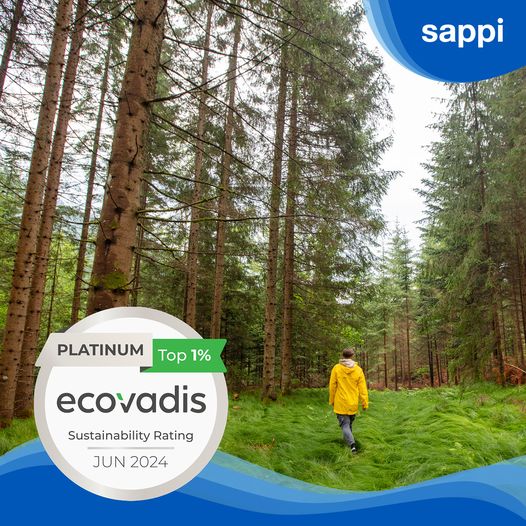
    Sappi has again achieved the highest platinum level in EcoVadis’ sustainability rating across all three of its manufacturing regions – Europe, North America, and South Africa.

    In line with Sappi’s business strategy, the organisation has consistently focused on its priority SDGs and collaborated with all its stakeholders to deliver measurable and tangible progress.

    Sappi, a leading global provider of everyday materials made from woodfibre-based renewable resources, has again achieved Platinum, the highest rating in EcoVadis’ sustainability assessment across all three of its manufacturing regions – Europe, North America, and South Africa. Sappi continues to be among the top 1% of the companies worldwide rated by EcoVadis in the manufacture of pulp, paper and paperboard category. In 2018-2019, Sappi received EcoVadis gold medal, which was the highest level until the Platinum category was introduced in 2020.

    Sappi’s global business strategy focuses on growing its business, enhancing trust, and driving collaboration and innovation as a sustainable, diversified global woodfibre group.

    “At Sappi, we recognise that sustainability is about investing in people-centric, positive change. We are immensely grateful for the ongoing collaboration with EcoVadis, and we look forward to continuing this strategic approach, regionally and globally, thereby innovating our sustainability efforts in areas where we can have the greatest impact.” says Tracy Wessels, Group Head of Investor Relations and Sustainability, Sappi.

    Understanding that EcoVadis can help Sappi’s suppliers on their own sustainability journey, Sappi partnered with EcoVadis since 2021 to benchmark and assess the sustainability practices of its suppliers. This strengthened Sappi’s ability to identify risks, assess social and environmental performance, and encourage commitment to sustainable choices across the value chain. It also aligns with Sappi’s commitment to create shared value, especially in the communities where it operates.  

  • Paper: Growth with Sustainability

    Paper: Growth with Sustainability

    Paper is an integral part of the daily lives of people. Paper is one of the most environmentally sustainable products as it is biodegradable, recyclable and is produced from sources which are renewable and sustainable. Paper can be recycled up to 6-7 times, making it one of the most recycled products in the world.

    Paperboard / packaging is crucial for almost all goods, especially all kinds of essential goods, FMCG, pharmaceuticals, food products, soaps, milk cartons, hygiene products, textiles, etc. Tissue paper helps in improving the hygienic conditions and is used in all health-conscious institutions / areas like hospitals, hospitality, etc. Similarly, writing & printing paper is essential not only for education and offices, but also for labels, pharmaceutical inserts, etc. Newsprint is required for printing newspapers.

    The key drivers for growth in paper consumption in India are many. Greater emphasis on education and literacy by the government coupled with growth in organised retail and demand for better quality paper are the major drivers for writing and printing paper. Demand for better quality and environment-friendly packaging of FMCG products marketed through organised retail, booming e-commerce, rising healthcare spends, over-the-counter medicines and increasing preference for ready-to-eat foods are the key demand drivers for paperboard / packaging paper.

    India’s Paper Industry has been closely associated with the national objectives of literacy, greening India, rural employment, and usage of sustainable resources, besides meeting paper needs of the Indian consumers.

    Around 75% of the total paper produced in India is from recovered fibre, that is paper recovered post-consumer use. The rest 25% is from virgin fibre, primarily wood which is grown by farmers as any other crop and sold to paper mills after harvesting it. India’s Paper Industry is agro / farm forestry based and substantial amounts have been spent by the Paper Industry on plantation R&D, production of high-quality clonal saplings with lesser rotation period, technical extension services to improve agro / farm forestry services, hand holding of marginal farmers over a gestation period of 4-5 years. This has generated significant employment opportunities for the local community, especially in the rural areas, with more than 5 lakh farmers engaged in raising plantations.

    The industry has been encouraging the growing of trees at a faster pace by the farmers for sourcing wood. Paper Industry’s plantation promoting activity has led to more than 12 lakh hectares of mainly marginal land in the country coming under green cover. This, apart from supplementing farm incomes and promoting rural employment, has helped significantly in carbon sequestration and other environmental benefits, and improved the sustainability of the industry.

    Contrary to the perception, paper is green, and it is never too early to switch to paper-based alternatives for the larger good of the environment. Two of the foremost global environmental issues are the disposal of single-use plastic and e-waste. Both these issues are addressed to a large extent by the use of paper as an alternative.

    Paper mills in India have been working towards better energy efficiency, green energy, employing a range of innovations and technologies, and thereby moving up the sustainability curve by reducing resource intensity and curbing its environmental footprint. Paper mills have also undertaken significant upgradation of process technology to comply with stringent environmental norms / standards to reduce freshwater consumption and effluent and emission generation. Specific water and energy consumption is being reduced continuously to lessen the carbon footprint. The industry is moving rapidly up the technology and sustainability curves matching with the world’s best.

    The Paper Industry in the last 15 years has taken some landmark initiatives. Be it creation of a robust and renewable raw material sourcing base, offering innovative, eco-friendly alternatives to single-use plastic or incorporation of process technologies with least environmental footprint, Paper Industry has come a long way.

    The industry has taken significant leaps in the last few years in technological upgradation, process-optimisation and introduction of best practices. The industry has worked hard on reducing specific energy consumption. Under the PAT (Perform Achieve Trade) scheme of the Government for promoting energy efficiency, the Paper Industry has been one of the top performing sectors and has over-exceeded the mandated stiff targets.

    In fact, the industry has managed to bring down its energy consumption by about 20% in the last five years. Integrated paper mills in India generate over 40% of the power they use by utilising the biomass (renewable energy) from the pulping process.

    Till a few years ago, the industry used to consume 200 cubic metres of water to produce a tonne of paper. Now, the integrated mills have reduced that to under 50 cubic metres.

    Paper is being recognised globally as an environmentally friendly product promoting circular economy and not as an environment harming one as has been wrongly projected and propagated for years by vested interests.

    The negativities attached to the Paper Industry have been giving way to better appreciation of the industry’ efforts towards sustainability in government and policy making circles.

    All stakeholders need to support the industry that has strong backward linkages with the farming community, generates employment in rural areas, and significantly contributes to the national objective of bringing 33% of land mass in India under tree cover, apart from also significantly contributing towards the national objectives of education and literacy. Use more paper to save the environment!

    Article by Mr.Rohit Pandit, Secretary General, Indian Paper Manufacturers Association (IPMA)

  • Aiming for Emission-Free Pulping, Forest Industry and Scientific Community Join Forces

    Aiming for Emission-Free Pulping, Forest Industry and Scientific Community Join Forces

    Thanks to the strong support from the forest industry and public funding, 10 research organizations, universities, and companies are establishing a groundbreaking research program with around 20 full-time researchers. The Emission Free Pulping program aims to significantly reduce biomass burning and increase the product yield of wood material used for pulping from approximately 50% to around 70%. The program is projected to have a budget of around 15 million euros over the next five years.

    The forest industry, technology companies, research organizations, and universities have joined forces to revolutionize the traditional pulping processes under the joint leadership of VTT Technical Research Centre of Finland and RISE Research Institutes of Sweden. The Emission Free Pulping research program intends to find ways to improve energy efficiency, enhance the efficiency of wood usage and conversion to products, achieve emission-free pulping (especially carbon dioxide emissions), and significantly reduce water usage in the processes. 

    “Due to the limited nature of forest resources, the growth opportunities for the industry are constrained. Moreover, the burning of biomass in the pulping process results in the emission of biogenic CO2. To significantly enhance resource efficiency and increase the value added from wood, revising the chemical processes and unit operations used in the pulping process is essential,” says Atte Virtanen, Vice President of biomaterial processing and products at VTT.

    So far, five industrial companies have committed to the program, and they will bring in their knowledge about industrial relevance and operations as well as financial contribution. ANDRITZ, Arauco, Metsä Group, Stora Enso, and Valmet have committed to a five-year collaboration with the research organizations and universities for this program. The program has been granted substantial funding from Business Finland, amounting to over 5 million euros over a three-year period.

    “Long-term research cooperation between companies, research organizations, and universities is essential for solving major sustainability challenges. With the financing of this joint project, we want to speed up the renewal of the forest industry, which is of paramount importance for Finland’s competitiveness,” says Executive Director Timo Metsä-Tokila from Business Finland.

    “We are deeply committed to the vision of a thriving forest-based ecosystem that delivers the full value of Nordic wood. The key to achieving this lies in fostering innovation and coming together as an industry and as a research ecosystem. By combining our efforts, we can drive advancements that not only enhance efficiency but also uphold our commitment to environmental stewardship. It’s about creating a future where sustainable wood use and more resource-efficient pulping methods go hand in hand, ensuring the longevity and prosperity of our forests and the industries dependent on them,” says Katariina Kemppainen, SVP Group R&D at Metsä Group.

    The expertise and knowledge being developed will be internationally groundbreaking, and the program’s sought-after results are expected to have wide-ranging effects. 

    “We celebrate that other companies and universities share our view on the necessity to use science and joint research for enabling significant improvement of the material yields from pulping and thereby reducing emissions. Can we reach zero? Let’s see what academia and industry develop together, based on science, knowledge, and inclusion of industrial realities from start to end in the program,” says Mikael Hannus Senior Vice President, Group Innovation R&D, at Stora Enso.

    International collaboration across sectors 

    Strong commitment from leading universities in both Finland and Sweden creates the conditions for the success of the project. The project involves significant contributions from Aalto University, Chalmers University of Technology, KTH Royal Institute of Technology, LUT University, Mid Sweden University, University of Helsinki, University of Oulu, and Åbo Akademi University. 

    The Finnish public funding enables the hiring of the initial group of scientists that will be expanded with further funding from the companies involved. The goal is to form a group of 10-20 researchers focusing full-time on advancing the research agenda collectively agreed upon by the consortium. 

    Public funding is currently being sought also in Sweden, and doors are open to new corporate partners. 

    “The key to success lies in open collaboration. This is why we invite industry leaders and scientists from around the world to join our consortium, participating in spearheading research that aims to transform pulping processes for better energy and material efficiency,” says Per Tomani, Director of Research & Business Development at RISE Research Institutes of Sweden.

    “The challenge is common to the entire industry; no one can solve it alone. Technology plays one key role in the evolution of the pulp and paper industry. This transformation is not just about meeting industry standards; it’s about setting new benchmarks for environmental responsibility and operational excellence. The focus needs to remain on innovation and collaboration to drive this vital change in the industry,” concludes Johan Engström, CTO, ANDRITZ.

    Emission Free Pulping – in a nutshell

    • A 5-year international research program.
    • Consortium coordination VTT, scientific lead RISE.
    • Business Finland granted the program with a 3-year funding of 5.1 million euros.
    • The total budget is expected to exceed 15 million euros.
    • Companies involved: ANDRITZ, Arauco, Metsä Group, Stora Enso, Valmet.
    • Universities and research institutions involved: VTT, RISE, Aalto University, Chalmers University of Technology, KTH Royal Institute of Technology, LUT University, Mid Sweden University, University of Helsinki, University of Oulu, Åbo Akademi University.